 Since Russia’s full-scale invasion of Ukraine on 24 February 2022, the country’s energy system has ceased to be merely collateral damage. By the autumn of that year, missile and drone strikes on power plants, substations, district heating networks and fuel depots had become a recurring campaign. The aims are military, economic and psychological: to weaken industry, disrupt logistics and make everyday life unbearable, especially in winter.
Plunging a country into darkness
The scale of Ukraine’s vulnerability reflects the system it inherited from the Soviet era: powerful, centralised and interconnected. Before the full-scale invasion, the country had around 38 gigawatts of generating capacity. According to the International Energy Agency, 19 GW fell under occupation or were destroyed or damaged during the first year of the war. Following the wave of attacks in spring 2024, only 12 GW remained available. Repairs have restored several gigawatts, but every facility brought back into service remains vulnerable to another strike. The three nuclear power plants still operating in areas controlled by Kyiv alone account for around half of the available generating capacity. They help stabilise the grid, while making its security heavily dependent on a small number of sites.
The joint assessment published in February 2026 by the World Bank, the European Union, the United Nations and the Ukrainian government shows how much the situation has deteriorated: damage to energy assets rose by a further 21% or so in 2025. Generation, electricity transmission and distribution, district heating and gas infrastructure are all being hit at once. Repairs no longer mean returning to normal, but keeping a system running under fire.
An emergency decision prevented complete isolation. On 16 March 2022, three weeks after the invasion, Ukraine’s and Moldova’s electricity grids were synchronised with the continental European network. This connection allows imports when supplies are short and exports when generation permits. In 2024, Ukraine purchased a record 4,436 GWh from its neighbours. Power lines have thus become both a lifeline and a new geopolitical anchor.
Life between power cuts
A nationwide blackout means far more than losing the lights. Without electricity, water pumps stop, mobile networks falter, lifts grind to a halt, shops lose refrigerated stock and hospitals switch to backup generators. When district heating and gas supplies are also targeted, an outage becomes a direct threat to health.
On 23 January 2026, after renewed strikes and with temperatures falling as low as −20°C, more than a million Ukrainians were left without electricity, water or heating. The European Commission responded by sending 447 emergency generators; almost 10,000 had already been delivered since 2022. These machines keep essential services running, but they also reveal how fragile that resilience is, dependent on diesel, spare parts and a continuous international supply effort.
For residents, energy warfare imposes an unseen daily discipline: charging devices as soon as the power returns, storing water, fitting work and meals around scheduled outages, and finding a warm place of refuge with internet access. The effects are uneven. Older people, those who are ill or disabled, low-income families and communities near the front have fewer backup options. The destruction of a substation hundreds of kilometres away can interrupt medical treatment, an online class or a village’s supplies.
The social crisis is also accompanied by widespread pollution. Fires at fuel depots and industrial facilities release toxic fumes; damaged sanitation networks contaminate water; and the widespread use of generators brings emissions into residential neighbourhoods. In wartime, the line between humanitarian emergency and environmental harm begins to disappear.
Lost megawatts and contaminated land
The most lasting damage is not always the most visible. Explosions and munitions disperse lead, mercury, arsenic and other substances that can reach soils, groundwater and, eventually, the food chain. The European Commission’s Joint Research Centre notes that agriculture still accounted for 11% of Ukraine’s GDP and 60% of its exports in 2023. Contamination compounds the erosion and degradation of some of Europe’s most fertile land.
Forests are another front. In 2024, satellites recorded 965,000 hectares burned in Ukraine, more than twice the area affected by fires across the entire European Union that year. The largest fires largely follow the front line. Shelling sparks fires, while mines, unexploded ordnance and ongoing fighting prevent firefighters from reaching them and make restoring ecosystems harder afterwards.
The breach of the Kakhovka dam on 6 June 2023 exposed this vulnerability on a regional scale. Flooding downstream, the drying of the reservoir and the release of contaminated sediments affected drinking water, irrigation, and habitats along the Dnipro and in the Black Sea. The United Nations Environment Programme estimates that some of the damage is irreversible and that its effects on ecosystems and human health could last for decades.
Yet the full extent of this environmental legacy remains difficult to establish. Areas under occupation, strewn with mines or close to the fighting are often inaccessible to field sampling; monitoring stations themselves may have been destroyed. Reconstruction therefore also requires restoring networks that monitor air, water, soil and coastal conditions. Without comparable, publicly available data, pollution risks becoming an unseen burden carried into the post-war years.
Breaking with Russian gas and rebuilding differently
This energy war has brought about a European shift that years of debate had failed to achieve. Between 2018 and 2021, Russia supplied an average of more than 40% of the EU’s gas demand. By 2025, its share had fallen to around 13% of imports, but those imports were still worth more than €15 billion. In January 2026, the EU’s 27 member states gave final approval to a phased ban on Russian gas. The ban is due to take full effect during 2027 for both liquefied natural gas and pipeline gas.
This break weakens a major source of Moscow’s political leverage. On its own, however, it does not amount to a green transition. Replacing Russian pipeline supplies with liquefied natural gas from elsewhere diversifies suppliers, but preserves dependence on fossil fuels and costly infrastructure while creating new vulnerabilities. Energy security and decarbonisation will advance together only if lower imports go hand in hand with energy efficiency, electrification, renewables and reduced energy use.
Ukraine brings this dilemma into sharp focus. Rebuilding large, centralised power plants could quickly restore substantial capacity, but would also recreate easily identifiable targets. The International Energy Agency recommends combining these facilities with distributed resources: solar, wind, batteries, local combined heat and power, and small-scale dispatchable generation. A network made up of many units is harder to cripple in a single strike. It can also bring generation closer to the hospitals, businesses and municipalities that rely on it.
At the Ukraine Recovery Conference in Gdańsk in June 2026, the European Commission announced €100 million in guarantees to help stabilise Ukraine’s energy system, restore renewable capacity and improve energy efficiency. The challenge extends beyond funding, however. Choices will have to be made between immediate needs and long-term planning, large power plants and microgrids, physical protection and open data, upfront costs and future pollution.
The war has not made the green transition a “collateral benefit”. It has exposed the human and strategic cost of dependence. It has also shown that energy is not simply one sector among many: it is the infrastructure that allows all the others to function. In Ukraine and across the European Union, energy sovereignty will increasingly be measured less by the volume of fuel in storage than by the ability of networks to withstand shocks, recover and adapt without sacrificing the places they are meant to protect.
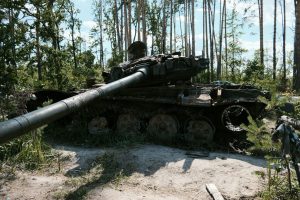
Image: A destroyed Russian tank in a forest in the Kyiv region. Photo: Alex Fedorenko / Unsplash (royalty-free image).
* Estefania Granda Orozco holds a Master’s degree in Sustainable Management and Social Impact from ESSCA School of Management in Paris.
Link to the French version of the article
To cite this article: Estefania Granda Orozco (2026), “Ukraine at the Heart of Europe’s Energy Shift”, Regard sur l’Est, 19 October.