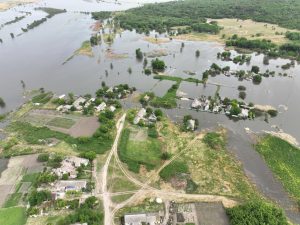
 The dead, the displaced and the destroyed cities provide the most immediate measure of the war. Yet its ecological footprint, too, will affect generations to come.
311 million tonnes: the war’s third front
In February 2026, the Initiative on GHG Accounting of War estimated that the conflict had generated 311 million tonnes of CO₂ equivalent (CO₂e, a unit that expresses different greenhouse gases in terms of their global warming potential) since 24 February 2022. This total, of the same order of magnitude as France’s annual emissions, had risen by 75 million tonnes during the fourth year of the war. It includes emissions already generated by military fuel consumption, munitions, fires, leaks from energy infrastructure and diverted flight routes, as well as an estimated 73.3 million tonnes of future emissions associated with rebuilding Ukraine’s destroyed infrastructure.
These figures are not an exhaustive inventory: they rely on attribution methods, satellite imagery and assumptions made necessary by the inability to access parts of the territory. Nevertheless, they reveal a clear trend. In 2025, 1.39 million hectares of natural landscapes burned across Ukraine, following an already record-breaking fire season in 2024, when the European Commission’s scientific service, the Joint Research Centre (JRC), recorded 965,000 hectares affected by fires. Heat and drought also play a part, but the fires are concentrated near the front line, where shelling, mines and the inability to intervene can turn a spark into a disaster.
The breach of the Kakhovka dam on 6 June 2023 remains the defining symbol of this ecological front. The sudden draining of the reservoir and flooding downstream disrupted habitats along the Dnipro River, stirred up contaminated sediments and affected drinking water supplies and irrigation. The United Nations Environment Programme considers some of the damage irreversible, with consequences for ecosystems and human health that will persist for decades.
Added to this are soils riddled with munitions, mined forests, burning fuel depots, damaged industrial facilities and disrupted water and energy networks. Not every site is necessarily targeted for its ecological value. But the accumulation of foreseeable and lasting destruction means that nature can no longer be relegated to the status of mere “collateral damage”.
Ecocide: an old word, a crime still missing
The term “ecocide” gained prominence in the early 1970s in the wake of the environmental destruction caused by the Vietnam War, notably the US military’s large-scale spraying of herbicides over forests and crops. In 1972, at the Stockholm Conference, Swedish Prime Minister Olof Palme denounced this destruction of the natural environment. Half a century later, the term’s force remains primarily moral.
In June 2021, an international panel of legal experts proposed defining ecocide as unlawful or wanton acts committed with knowledge that there is a substantial likelihood of severe and either widespread or long-term damage to the environment. Intended to inform an amendment to the Rome Statute, this definition covers both peacetime and wartime and does not require proof of an intention to destroy nature for its own sake.
The Ukrainian paradox is that national law anticipated this debate. Article 441 of Ukraine’s Criminal Code has criminalised ecocide since the Code was adopted in 2001. It covers the mass destruction of flora or fauna, the poisoning of air or water, and acts liable to cause an environmental disaster, punishable by eight to fifteen years’ imprisonment. This provision forms part of a legal tradition found in several post-Soviet states; however, it had generated very little judicial practice before the 2022 invasion.
In The Hague, ecocide is still not the “fifth international crime” (1). The Rome Statute explicitly protects the environment only through Article 8(2)(b)(iv), which applies to international armed conflicts. It requires proof that an attack was launched in the knowledge that it would cause widespread, long-term and severe environmental damage that would be clearly excessive in relation to the anticipated military advantage. This cumulative and exceptionally high threshold has yet to result in a conviction by the International Criminal Court (ICC).
Two developments have nevertheless opened the door. In September 2024, Vanuatu, together with Fiji and Samoa, submitted a proposed amendment to create a standalone crime of ecocide. Then, in December 2025, the ICC Office of the Prosecutor adopted a policy on environmental damage: it aims to investigate more systematically how such harm may constitute, facilitate or reveal crimes already covered by the Statute. The policy does not establish a new offence, but it brings the environment out of the blind spot of international investigations.
Kyiv turns ruins into evidence
To prosecute a crime, naming it is not enough: the damage must be dated, located and measured, and linked to a decision and to the person responsible. This is where Ukraine’s experience stands out. The public EcoZagroza platform collects geolocated reports of air, water and soil pollution in real time. Meanwhile, Ecoaction and Greenpeace have documented nearly 900 potential cases of environmental damage and highlighted 30 particularly serious incidents on a publicly accessible map.
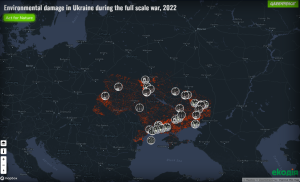
Ecocide in Ukraine
The challenge is immense. Investigators must establish an ecosystem’s baseline condition, distinguish the effects of fighting from those of climate change or pre-existing pollution, preserve samples that will be admissible in court, and identify the responsible level of command. In occupied or mined areas, access may remain impossible for years. Meanwhile, pollutants spread and craters disappear: ecological evidence deteriorates too.
There are also several possible routes to accountability. Ukrainian prosecutors can invoke Article 441, but enforcing any sentence would require the accused to be within the court’s jurisdiction. The ICC can prosecute certain acts as war crimes, crimes against humanity or genocide if their legal elements are met; it cannot simply add “ecocide” to an indictment. As for the Special Tribunal for the Crime of Aggression against Ukraine, established by an agreement with the Council of Europe signed on 25 June 2025, and whose management framework was agreed by 36 countries and the European Union in May 2026, its mandate concerns the crime of aggression and senior leaders, not environmental damage as such.
The path towards compensation is making more concrete progress. The Register of Damage for Ukraine, established under the auspices of the Council of Europe, now includes category B3.1 for environmental damage and category B3.2 for the looting or appropriation of natural resources. It is not a court and does not yet determine compensation amounts, but it organises the submission of claims to a future international commission. This is nevertheless a major innovation: soils, waters, forests and the ecosystem services they provide are becoming part of the framework for war reparations.
Europe moves forward, Rome still hesitates
European law is evolving faster than international criminal law. EU Directive 2024/1203 requires tougher penalties when certain offences cause destruction or widespread, substantial, irreversible or long-lasting damage to a large ecosystem, or to air, soil or water. Its preamble states that these qualified offences may encompass conduct comparable to ecocide. Member States were required to transpose the Directive by 21 May 2026. However, it is primarily designed to punish unlawful activities covered by EU environmental law, not to judge the conduct of a war.
The Council of Europe has taken another step. Its Convention on the Protection of the Environment through Criminal Law, adopted in May 2025 and opened for signature on 3 December that year, is the first binding international treaty devoted entirely to environmental crime. In particular, it makes it possible to prosecute intentional acts causing a disaster comparable to ecocide. But it will enter into force only after ten ratifications, including eight by member states: a considerable gap remains between the proclamation of a principle and an operational legal framework.
Ukraine alone cannot, therefore, guarantee the emergence of a fifth international crime. What it does is compel institutions to confront their legal categories with a documented reality: contamination, fires, desiccation and landmines can render a territory dangerous or uninhabitable just as surely as the destruction of buildings. Sovereignty is no longer simply a matter of defending a border; it also means preserving the material conditions of life within it.
The legal battle will be long. It will pit the demands of evidence and individual criminal responsibility against harms that are diffuse, cumulative and sometimes transboundary. But one fundamental shift has already occurred: the environment is no longer merely something to be restored once peace returns. It is becoming a victim whose suffering must be documented during the war, a harm for which reparation must be made and, perhaps one day, the subject of a standalone international crime. In this sense, Ukraine has not yet brought ecocide to trial; it is building the case.
Note
(1) The four crimes currently within the jurisdiction of the International Criminal Court are genocide, crimes against humanity, war crimes and the crime of aggression (Rome Statute, Article 5).
Cover image: Flooding in Kherson Oblast (10 June 2023) following Russia’s destruction of the Kakhovka dam (source: Wikimedia Commons).

Link to the French version of this article
* Assen Slim is Professor of Economics at Inalco.
To cite this article: Assen SLIM (2026), “Ukraine: Putting the War Against the Living World on Trial”, Regard sur l’Est, 14 September.