 The economic case for a Russian contribution is strong: the war imposes costs on Ukrainian households, businesses and local authorities, as well as on the countries supporting Ukraine. Using assets belonging to the state responsible would make it bear part of that burden. The aim is to distribute the cost of destruction so as to reduce the burden on victims and on partner countries’ budgets.
Making Russia contribute to reparations
The urgency strengthens this argument. A destroyed power station, a closed school or an unusable water network generates losses that accumulate over time. Swift repairs can limit disruption to economic activity, interruptions to healthcare and population displacement. Predictable funding would help the Ukrainian authorities plan reconstruction work and maintain public services. According to an assessment published in February 2026 by the World Bank, Ukraine, the European Commission and the United Nations, reconstruction and recovery needs amount to nearly $588 billion over ten years. This economic estimate should not be confused with the legally established amount of reparations owed.
The expected effect nevertheless needs to be clarified. Since the reserves are already immobilised, confiscating them would not deprive Moscow of cash currently available to finance the war. It would eliminate the possibility of recovering them in the future and provide resources for Ukraine. The measure could also increase the anticipated cost of aggression, although this deterrent effect is difficult to quantify. Its immediate effect would primarily be to strengthen Ukraine’s financial capacity.
An obligation to make reparations, but disputed access to the funds
The obligation to make reparations and the ability to seize an asset abroad are two separate questions. Sovereign assets, particularly those of central banks, benefit from protections linked to immunity. Some legal scholars argue that they can be used as a countermeasure in response to aggression and the refusal to provide reparations. Others dispute, in particular, the authority of third countries to adopt a permanent measure, given that countermeasures should, in principle, allow a return to compliance. European Parliament studies document these disagreements.
This uncertainty explains the search for intermediate arrangements, including loans linked to reparations. Above all, it means that immobilised assets cannot be presented as a pot of money that can be accessed by a simple political decision. Any defensible measure must specify its legal basis, the assets concerned, the procedures for challenging it and how it relates to Ukrainian claims. The strength of the economic argument does not remove the need for such a legal framework.
Confidence in currencies and the sharing of risks across Europe
Using Russian assets raises a question of confidence. Some central banks might reduce their investments in Europe if they consider their reserves there to be more exposed to political decisions.
Lower demand for European securities could ultimately increase financing costs. But predicting a general crisis of confidence would be just as imprudent as dismissing the risk. An analysis published by the ECB in 2025, based on data up to the end of 2024, found a limited decline in official holdings of euro-area debt by countries not aligned with the West, excluding Russia. Overall foreign official holdings nevertheless held up, and the estimated effect on bond yields remained very small. These observations cannot predict the consequences of any future confiscation.
Reserve managers also seek liquid markets, safe assets and readily convertible currencies. Alternatives to the euro and the dollar come with their own constraints. To preserve confidence, European countries should therefore establish a coordinated arrangement with a clear legal rationale and procedural safeguards. Predictable rules matter as much as the choice of instrument.
The risks are currently particularly concentrated in Belgium. Based in Brussels, Euroclear Bank is an international central securities depository that holds a large share of the immobilised Russian assets. It records securities, settles transactions and processes interest payments and redemptions. By enforcing European sanctions, it prevents the Russian central bank from accessing the assets concerned. On 12 December 2025, the latter brought proceedings before a Russian court seeking compensation for the harm it considers it has suffered. A ruling in favour of the Russian central bank was issued on 15 May 2026 and upheld on appeal on 16 July 2026. Euroclear, however, disputes the jurisdiction of the Russian court and stresses that these decisions are not recognised under European law. They could nevertheless prompt attempts at enforcement in other countries, whose outcome would depend on local rules.
One possible way out of the impasse would be to reorganise the custody of the assets even before deciding on their ultimate use. Distributing them among several institutions could reduce the exposure of any single player to Russian pressure. Another approach, advocated by the proponents of the “Russian Transfer”, would move the immobilised accounts into a joint European structure. This body would take over the assets as well as any potential obligations to return them to the Russian central bank, whose rights would remain on record. The aim would be for the European Union to assume the risks rather than leaving them mainly with Euroclear and Belgium.
Such a reorganisation would not, however, resolve the legal debate on its own. A transfer would need to be authorised and specify who would be liable for restitution claims, possible losses and litigation already under way. Distributing the funds without sharing the corresponding obligations could leave Euroclear exposed while depriving it of the resources needed to meet those liabilities. The involvement of a Ukrainian depository could be considered as a hypothetical option, subject to specific safeguards concerning its technical capacity, operational security in wartime and the preservation of the rights attached to the immobilised assets. Changing the custodian would not in itself make the funds available to Ukraine.
Joint management could harmonise investment practices and improve oversight. It would not automatically generate higher income. Seeking a higher return may mean longer investment maturities, lower liquidity or greater exposure to losses. Euroclear has, moreover, reported that income from Russian assets fell in the first half of 2026 as interest rates declined. Any new strategy would therefore have to specify who would bear potential losses and guarantee the availability of funds should they need to be returned.
Organising reparations without counting resources twice
How the funds are used would be just as important as where they come from. Their use would have to be coordinated with the international reparations mechanism: the Register of Damage receives claims. The International Claims Commission, established under a convention signed in December 2025, will be responsible for examining them and determining compensation. As at 6 October 2026, ten states and the EU had ratified the convention, which requires 25 ratifications and sufficient financial commitments to enter into force. A compensation fund has yet to be established. Documenting damage, establishing claims and paying beneficiaries are therefore separate stages.
Governance involving the Ukrainian authorities, independent audits and public disclosure of how funds are allocated would make it easier to monitor spending and prevent double compensation. It should distinguish between support for immediate defence, reconstruction and compensation for harm. Any new arrangement should also preserve the funding used to repay EU–G7 loans, currently provided by income generated from immobilised assets, or identify replacement resources.
Russian assets thus represent a potentially significant, but limited, contribution to reparations. They cannot under any circumstances replace continued international support. Using them requires Europe to organise Russian accountability, oversight of the funds and the sharing of risks. Without this last condition, the cost of the war would continue to fall on Ukraine, while the cost of the European decision would be concentrated on the actors most exposed.
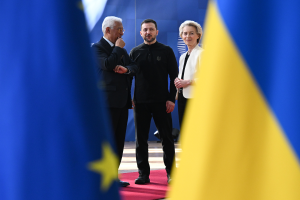
Image: The heads of the EU institutions and the President of Ukraine have held repeated meetings to ensure continued support for Ukraine (© Council of the EU).
* Assen Slim is a Professor at INALCO.
Link to the French version of the article
Suggested citation: Assen Slim (2026), “Frozen Russian Assets and the Cost of the War in Ukraine”, Regard sur l’Est, 16 November.