 Indonesia and the USSR first established diplomatic relations in 1950. The first few decades of the relationship were dynamic, the key foundation being the personal links between Khrushchev and Sukarno. The former Soviet leader particularly appreciated Sukarno, as he described in the third volume of his memoir: “Sukarno has both. He is educated and also smart”. Sukarno was Indonesia’s first president and founding father, and sympathized with socialist ideals. The Soviet-Indonesia relationship at the time was one of the most emblematic examples of Cold War diplomacy in the Global South. Key developments during this period were Soviet-backed infrastructure projects, notably a loan to assist Indonesia in building the Gelora Bung Karno stadium in the 1960s, significant foreign direct investment, and the supply of modern armament. Both leaders shared a vision of resisting Western dominance during the Cold War. During the West Irian dispute between 1961 and 1962, the Soviet Union provided military aid enabling Indonesia to further pressure its Dutch adversary. There had also been strong speculation regarding the USSR’s involvement in supporting Indonesia’s Communist Party (PKI) which at the time was the third largest after China and the USSR.
In 1991, Jakarta recognized the Federation of Russia as the USSR’s successor. However, relations deteriorated under Sukarno’s successor, the right-wing and autocratic Suharto, who outlawed PKI. Relations stabilized after the fall of his regime in 1998. Since the large-scale war in Ukraine broke out in 2022, Indonesia supported the United Nations’ resolution condemning the war, without directly supporting the sanctions deployed by the West, nor outrightly condemning Russia. Some Indonesian academics consider this war a proxy war between the West (notably NATO) and Russia rather than Russia and Ukraine - and that the latter should adopt a neutral stance due to its small stature as a country. Moreover, according to a report published by the Pew Research Center in 2025, 64% of Indonesians have a favorable view of Russia.
Implications of Increasing Bilateral and Multilateral Arrangements
Within the context of the war in Ukraine, Russia has been actively seeking channels to circumvent sanctions and its diplomatic isolation, it has generally been looking to the Global South as an alternative, specifically Asia. As for Indonesia, its closer financial movements to Russia are notably characterized by its accession to BRICS on 6 January 2025 and the signature in December 2025 of a Free Trade Agreement (FTA) with the Eurasian Economic Union (EAEU), comprised of Russia, Armenia, Belarus, Kazakhstan and Kyrgyzstan. In 2024, Indonesia’s trade with the EAEU amounted to USD 4.1 billion. Despite this being relatively modest, the recently signed FTA is expected to double trade between both countries in the next few years. The EAEU has granted Indonesia preferential rates on 90.5% of its total tariff line, while Indonesia reciprocated by granting extensive preferential tariffs on around 90% of EAEU goods, reducing the average tariff from 10.2% down to 2%. Through the EAEU, Indonesia primarily exports agricultural and industrial products, while Central Asian members export products such as wheat, fertilizers and petroleum.
Indonesia is also searching for additional revenue streams in the face of increasing European surveillance, which often criticizes what it considers excessive exploitation of the country’s natural resources. Its accession to BRICS has therefore been faced with some concerns: in the eyes of its Western partners, Indonesia’s long-standing diplomatic tradition of bebas dan aktif -grounded in an independent and active stance, as well as non-alignment- seems to be under challenge. Under the Trump Administration, this new orientation now exposes Jakarta to a risk of retaliatory tariffs. On 7 July 2025, the US threatened to apply an additional 10% tariff rate on BRICS’ member states. However, Indonesia’s direct neighbors have not expressed any direct criticism towards its membership.
Jakarta and Moscow have also been bilaterally exploring prospects on the interoperability of Indonesia’s national QR-code payment system, QRIS, with Russia’s MIR payment network. For Indonesia, this further pushes its free and active tradition. For Russia this settlement would allow it to partially bypass dollar-dominated payment rails. For both countries, it enables a freer flow of trade. Despite this not being a BRICS arrangement, it still pushes its wider agenda of de-dollarisation. This initiative has no stated deadline, but should it come to fruition, it can be expected to be met with backlash from Washington.
Strategic Partnership: fears and incertitudes
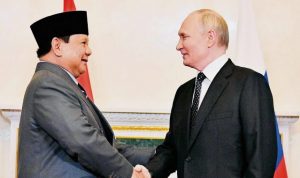
It is noteworthy to mention that Jakarta and Moscow have revised a new Strategic Partnership in July 2025, with the goal of deepening collaboration in fields such as economy, education, culture, energy, and environment. During the press conference following Prabowo and V. Putin’s meeting, the Russian president declared: “I want to emphasize that Indonesia is a key partner for the Russian Federation in the Asia-Pacific region”.
The most delicate aspect in the renewed partnership is defense and security cooperation, which for Western observers, is the main point of attention in the evolution of bilateral relations. This indicates an important shift in Indonesia’s foreign policy that traditionally mostly maintains Western defense partnerships. Both countries pledged in 2025 to organize regular meetings with their respective Ministers of Defense, although the security aspect of the Partnership is established on legitimate foundations: between 2006 and 2021, 12% of Indonesia’s foreign procurements were Russian; between 4 and 8 November 2024, the navies of Indonesia and Russia conducted Orruda 2024 in the Java Sea, the first ever bilateral joint naval exercise. In the future, training programs and joint military exercises will be expanded, including technology and personnel exchanges, port visits, as well as the development of military-technical cooperation. Indonesia is also negotiating additional weapons procurement from Russia for the 2025-2030 period.
Since Prabowo’s election in 2024, Indonesia has simultaneously signed armament contracts with France, China, and Turkey. Although this diversification reflects a logic of strategic hedging, the country’s defense posture remains ambiguous. These sudden procurements are causing anxiety and confusion for its neighbor, Australia, who has also been keeping close watch of Russia-Indonesia relations. On 17 April 2025, Canberra shared intelligence of Moscow allegedly requesting access to an airbase in the Indonesian province of Papua. Jakarta denied the claims, while Russia neither confirmed nor denied them. Indonesia’s direct neighbors, such as Malaysia and Singapore, have thus far not expressed any concern for the increased rapprochement, and have maintained a neutral tone, reflecting ASEAN’s principle of non-alignement. However, if Russian movements in the region increase, Southeast Asia would likely react at the behest of the United States.
A bigger role for Indonesia alongside the Big Three?
Jakarta’s movements today reflect Prabowo’s ambition for diverse partners. His presence by invitation at the People’s Liberation Army parade can be interpreted as Chairman Xi Jinping’s attempt at reinforcing China’s appeal to Indonesia. Beijing is giving an idea of what it has to offer as a military power, and the potential assurances that it could provide to Indonesia, a geostrategically important country through which the vital Malacca Strait runs through, one of the most vital maritime routes in the world.
As for relations with Russia, we can only speculate its evolution going forward- assuming Indonesia maintains non-alignement, the partnership will remain as such, with both countries benefitting from increased trade. On the other hand, if Prabowo starts to favor the East over its traditional Western partners, it could make way for a truly material strategic partnership. However, the prospect of a Russian base in Indonesia does not seem to, at first glance, align with Moscow’s current military aspirations. Ultimately, Jakarta’s growing proximity to Moscow creates new avenues for Russian influence in the Indopacific, and positions Indonesia as a facilitator of deeper Russian engagement with ASEAN who has been approaching Mekong countries.
Thumbnail: Prabowo Subianto alongside Russian President Vladimir Putin in Saint Petersburg, on July 19, 2025 (copyright : Laily Rachev/Wikimedias Commons).

* Joseph de Souza is a student at INALCO, specializing in the Indopacific region, notably Australia and Southeast Asia, on issues pertaining to security and energy. His previous experiences include an internship at the petrol company Maurel & Prom.
To cite this article: Joseph DE SOUZA (2026), “Russia: Indonesia’s curious rapprochement – Strategic hedging or silent alignment?” Regard sur l’Est, March 16.