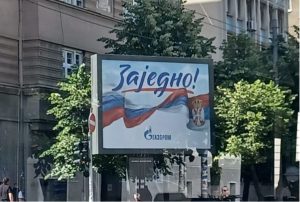
 On 8 August 2026, as Ukrainian President Volodymyr Zelensky made his first official visit to Serbia and was welcomed at the Palace of Serbia, bedecked with Serbian and Ukrainian flags, billboards advertising Serbia’s national oil company NIS and its Russian counterpart Gazprom could still be seen around Belgrade. They displayed intertwined Serbian and Russian flags alongside the word ‘Zajedno!’ (‘Together!’ in Serbian). A simple stroll through the Serbian capital thus offered a telling illustration of the country’s political double game towards Russia, Ukraine and the EU, against the backdrop of an increasingly multipolar international order, war on European soil and Serbia’s EU accession process: the country has been a candidate since 2012.
Russia, Serbia’s historically privileged partner
The ties between Serbia and Russia date back to the nineteenth century, when the two nations fought against the Ottoman Empire, their common enemy, and continued through the two world wars in the twentieth century. After relations cooled during the Cold War under Tito, they revived following the break-up of Yugoslavia, and particularly after the Yugoslav wars ended in the early 2000s. Today, alongside the emphasis placed on the religious and cultural affinities of the two peoples, Serbian-Russian relations remain close in several other areas.
In the energy sector, Serbia remains heavily dependent on Russian gas, which still accounts for 75% of its consumption thanks to preferential prices granted by Russia. Serbia is also dependent on Russian oil, although its share has declined, notably under pressure from the United States. The Serbian oil sector is dominated by NIS, which supplies 80% of domestic fuel demand and owns the country’s only refinery. NIS was placed under US sanctions in late 2025, since Gazprom and Gazprom Neft held 56% of its shares. Since then, NIS has secured successive waivers: the latest expired on 30 October, with a further extension granted until 11 December. Negotiations are still under way over the sale of the Russian stake to Hungary’s MOL, a transaction favoured by Washington.
On the diplomatic front, political contacts have been maintained through reciprocal official visits, most recently that of Serbian Interior Minister Ivica Dačić to Moscow in mid-October. Serbia can also count on Russia’s veto in the UN Security Council on matters relating to Kosovo, although the issue can remain sensitive.
Russia also wields considerable political and media influence, as numerous pro-government outlets (Informer, Pink TV and Večernje Novosti) relay Kremlin narratives.
Finally, Serbia refuses to implement Western sanctions, including those imposed by the EU, citing the harmful effects on its citizens of the sanctions it experienced in the 1990s at the hands of the United Nations, the United States and the EU. Serbia has also become one of the main destinations for Russians emigrating after 2022, thanks to visa-free travel between the two countries and regular air connections. Sanctions are therefore not on the agenda: most recently, at the Ukraine–South-East Europe Summit held in Kyiv on 15 July 2026, Serbia declined to sign a declaration calling for increased pressure on Russia.
Serbia’s multi-vector policy: pragmatism in pursuit of strategic autonomy and EU accession
Despite this close relationship with Russia, Serbia has chosen to move closer to Ukraine diplomatically and economically, adopting an ambiguous position. This multi-vector policy, which involves a strategy of diversifying its partners, allows Serbia to maximise its interests without aligning itself exclusively with any one bloc. Its relationship with Ukraine is intended to send signals to the EU, particularly its eastern member states (Poland and the Baltic countries), so that Serbia can present itself as an acceptable partner.
At the diplomatic level, this rapprochement can be seen in several ways. At the UN, Serbia has repeatedly condemned Russia’s full-scale invasion of 24 February 2022 and even voted in favour of suspending Russia from the organisation’s Human Rights Council. Just as Ukraine does not recognise Kosovo’s independence and supports Serbia’s territorial integrity, Serbia, for its part, does not recognise the self-proclaimed ‘people’s republics’ of Donetsk and Luhansk annexed by Russia. Serbia also provides Kyiv with humanitarian, financial and energy assistance, but no official military aid. However, it sells ammunition to Western partners, some of which is sent on to Ukraine; Belgrade thus provides indirect military support to the country, which has to some extent strained its relationship with Russia.
Economic ties are deepening too. During President Zelensky’s summer visit, a free-trade memorandum of understanding was signed (important for Serbia’s accession to the World Trade Organization, a condition for its accession to the EU), and both sides undertook to strengthen cooperation in fields such as infrastructure, food security and energy security. Moreover, Serbia was the only non-EU country to take part in the Carpathian Eight Summit (C8), a new diplomatic initiative launched by Zelensky to develop cooperation in strategic sectors.
Regarded by many experts as symbolic and transactional, these moves give Serbia new diplomatic and communication tools with which to demonstrate openness towards the West and Europe, while benefiting economically from these contradictory relationships. Yet the balance Belgrade seeks in order to maximise its room for manoeuvre is also undermining its EU integration process (alongside other domestic factors linked to the weakening of the rule of law), since Serbia does not align itself with the EU’s foreign policy. Could the recent parliamentary elections change the situation?
A change in foreign policy after the Vučić era?
On 1 November 2024, the canopy at Novi Sad railway station collapsed, killing 16 people. In the wake of the tragedy, a protest movement emerged, led by students calling for the restoration of the rule of law and a crackdown on corruption. Two years later, on 25 October 2026, the Student List (SL) won the parliamentary elections with 53% of the vote, against 39% for the formerly governing Serbian Progressive Party (SNS), the party of former President Aleksandar Vučić, who had resigned in late September to campaign and attempt to become prime minister. These elections brought 14 years of SNS rule to an end, raising questions about the future of Serbia’s foreign policy.
In fact, having been elected on a domestic policy platform driven above all by the desire to put an end to endemic corruption, the student movement has offered few details of its foreign-policy intentions. A grouping that is in many respects heterogeneous and brings together a broad range of political views, the Student List does not appear to have a clear vision of its strategy in this area. Although its programme calls for deeper cooperation with the EU, it does not explicitly express a desire to join. By contrast, it sets out its intention to maintain relations with Russia and its refusal to impose sanctions on it, while reaffirming the importance of respecting Ukraine’s territorial integrity and sovereignty. Iljia Srdanovic, a key figure in the SL, believes that foreign-policy decisions should be ‘taken by citizens’, hinting at possible internal disagreements over the prospect of EU membership and relations with Russia. Finally, concerning Kosovo, the movement maintains that it is an integral part of Serbia.
Thus, at this stage, uncertainty remains, but a profound geopolitical realignment does not appear to be taking shape in Serbian foreign policy. Belgrade’s balancing act seems destined to continue, albeit with closer ties to the EU, at least at the institutional and political levels.
Main sources
Photographs: Belgrade, 8 August 2026. © Constance Frollo de Kerlivio.
* Constance Frollo de Kerlivio is a second-year master’s student of International Relations at INALCO, specialising in Russian.
Link to the French version of the article
To cite the article: Constance Frollo de Kerlivio (2026), “Serbia: Will the Student List End the Ambiguities of Its Foreign Policy?”, Regard sur l’Est, 9 November.