 Since taking office as Prime Minister, Rumen Radev has sought to reshape a Bulgarian foreign policy long aligned with the positions of the European Union and NATO. His political programme promised a "dignified and proactive" Bulgaria, capable of defending its national interests more clearly while honouring its European and transatlantic commitments(1). Yet this ambition has produced a foreign policy that is difficult to interpret: compromise with Russia alongside European consensus on Ukraine, cooperation with the United States coupled with a refusal to involve Bulgarian territory in Middle Eastern conflicts, and firmness towards North Macedonia alongside pragmatism in relations with Greece and Turkey.
Is this multi-speed foreign policy consistent with Radev's electoral promises? Does it aim to restore Sofia's long-underused negotiating capacity? At stake appears to be the ability of a small EU and NATO member state to turn its membership of these organisations into instruments of influence rather than constraints requiring political alignment.
Between the European Union, Russia and Ukraine: Negotiating Without Breaking Away
It is in relations with the European Union that these ambiguities are most apparent. During his electoral campaign, Radev advocated a pragmatic approach to the war in Ukraine, prioritising de-escalation and a diplomatic solution. At the same time, his political programme promoted a "coherent" foreign policy based on clearly defined national interests and active participation in European decision-making.
As Prime Minister, he demonstrated this willingness to pursue a distinct position during negotiations over the EU's 21st package of sanctions against Russia in the summer of 2026. Sofia expressed reservations about adding several Russian figures to the European sanctions lists, including businessman Iskander Makhmudov, citing potential consequences for Bulgarian economic interests. The government also raised objections concerning Russian Sports Minister Mikhail Degtyarev, Patriarch Kirill of Moscow and Togliattikhimbank, a bank linked to Russian fertiliser producers. Sofia eventually withdrew these objections to allow a common European position to be adopted(2). However, Radev's cabinet also justified its opposition to sanctions against Patriarch Kirill on religious and cultural grounds.
The sanctions episode illustrates Radev's approach: negotiating before a decision is reached, then accepting a collective compromise when Bulgaria's essential interests do not warrant the use of a veto. This position falls somewhere between automatic alignment with Brussels and a break with European policy towards Moscow.
Relations with Kyiv remain equally ambiguous. Support for Ukraine has prompted strong criticism in Parliament. This was also the case during Foreign Minister Velislava Petrova-Chamova's visit to Kyiv on 15 July 2026, when the opposition party Vazrazhdane (Revival) accused the government of subordinating Bulgarian foreign policy to Ukrainian interests and linked the issue to the country's energy policy(3).
Nevertheless, describing Radev's foreign policy as simply "pro-Russian" would be reductive. Rather, it reflects an attempt to carve out greater national room for manoeuvre within the European consensus. After several years in which Sofia rarely sought to adopt an autonomous position in relation to EU policy directions, Radev appears to be testing Bulgaria's ability to negotiate specific exemptions, build occasional coalitions and make its support conditional on the consideration of Bulgarian economic or political interests.
United States, NATO and the Middle East: The Limits of Rebalancing
The pursuit of autonomy is even more delicate in transatlantic relations. In spring 2026, amid heightened tensions in the Middle East, Radev refused to extend the stationing of American aircraft in Bulgaria beyond 30 June, citing national security concerns and the lack of progress towards visa-free travel for Bulgarian citizens to the United States. Yet just a few weeks later, despite warnings from Tehran, the Bulgarian Parliament authorised the return of eight KC-135 aerial refuelling aircraft and 250 US military personnel to Bezmer Air Base until 1 October 2026. In practice, the aircraft left the base on 21 August. The Prime Minister had assured the public that no military operations against Iran would be conducted from Bulgarian territory and that the American aircraft would perform exclusively logistical functions. Nevertheless, the controversy sparked tensions in Parliament, with several political parties demanding explanations regarding the risks involved and the consistency of the decision(4).
The paradox is significant. A former commander of the Bulgarian Air Force, Radev does not challenge Bulgaria's Western military orientation. Instead, he seeks to redefine its political terms. Sofia therefore continues to host American forces and fulfil its NATO obligations while emphasising that such cooperation does not imply automatic support for every US military operation.
This distinction allows the government to maintain its strategic relationship with Washington and the Alliance without directly involving Bulgaria in a confrontation with Iran. However, by repeatedly distinguishing between military commitments, political solidarity and national interests, Radev risks sending contradictory signals to his allies, international partners and, above all, his electorate.
The Balkans: Where National Interests Take Priority Again
The concept of national interest is particularly evident in the Balkans. The Progressive Bulgaria programme seeks to position the country as a guarantor of stability, security and good-neighbourly relations in Southeastern Europe. The party supports the European integration of the Western Balkans but makes it conditional on the individual merits of candidate countries, good-neighbourly relations and respect for human rights. It also identifies Corridor VIII, connecting the Adriatic Sea to the Black Sea, as a strategic project serving Bulgaria's economic interests.
North Macedonia represents the clearest test of this approach. Bilateral relations remain marked by historical, identity-related and linguistic disputes, as well as the situation of citizens who identify as Bulgarian. In June 2026, the burning of vehicles belonging to the Bulgarian Embassy in Skopje heightened concerns in Sofia. It was the second act of vandalism targeting the embassy since the beginning of the year, amid other incidents affecting Bulgarians and Bulgarian cultural clubs, against a backdrop of growing concern in Sofia over what it considers increasingly anti-Bulgarian rhetoric(5). Less willing to compromise than in its dealings with European or transatlantic partners, Sofia nevertheless considers this firm stance compatible with its support for EU enlargement. Consequently, Skopje's European integration prospects become a means of obtaining guarantees on issues regarded as matters of national interest.
Relations with Greece follow a different logic. The issue of transboundary water management(6) demonstrates Sofia's preference for technical negotiations aimed at transforming a historically sensitive issue into a contractual arrangement. Discussions have focused on a temporary mechanism subject to annual monitoring and a possible commercial arrangement for services provided by Bulgarian infrastructure. This approach illustrates a transactional form of diplomacy: cooperation when compromise is possible, and firmness when an identity-related or security issues are considered essential.
Turkey, meanwhile, occupies a more complex position. A NATO member but not part of the EU, an economic partner and a strategic neighbour, it also features prominently in Bulgaria's security, migration and energy debates through the controversial agreement with BOTAŞ. The issue extends beyond bilateral relations, touching on energy security, regional infrastructure and Sofia's ability to reduce existing dependencies or, conversely, create new ones. Although Radev faced strong criticism over this agreement during his presidency, he succeeded in renegotiating its terms at the beginning of his premiership, notably to ease its financial burden.
Diplomatic Ambiguity or the Return of Negotiation-Based Diplomacy?
The first months of Radev's government have therefore revealed less of a geopolitical reorientation than an attempt to change the way Bulgaria uses its alliances. This strategy, supported by both the government and President Iliyana Yotova, has nonetheless generated contradictions.
Yet it can also be interpreted as an attempt to move beyond a predominantly reactive foreign policy. For a small state such as Bulgaria, autonomy does not necessarily mean maintaining equal distance from Brussels, Washington and Moscow. Rather, it may lie in the ability to identify the issues on which to negotiate, seek partners with converging interests and use European and transatlantic institutions as platforms for coalition-building. If Sofia succeeds in building coalitions and clarifying its priorities, this shift could mark the return of a more active Bulgaria on the international stage.
Sources :
(1) Programa na Progresivna Bulgaria, Progresivna Bulgaria, 2026.
(2) « Vanshniyat ministar obyasni pozitsiyata na Balgariya za 21-viya paket sanktsii sreshtu Rusiya », Nova.bg, 28/08/2026.
(3) Daniel Inkov, « Vazrazhdane razkritikuva vanshnata politika na pravitelstvoto » , BNR Horizont, 15/07/2026.
(4) Khristiana Dimitrova, « Naprezhenie v parlamenta zaradi vanshnata politika na pravitelstvoto », BNT News, 31/07/2026.
(5) « Palezhat na kolite na balgarskoto posolstvo v Skopie – sluchaen vandalizam ili provokatsiya? », Nova.bg, 16/06/2026.
(6) Maria Yordanova, « Sporazumenieto na Balgariya s Gartsia za vodite. Kakav e pravilniyat hod? », BNR Horizont, 17/06/2026.
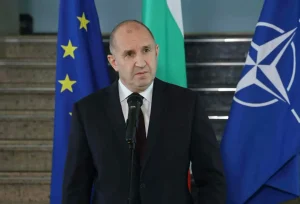
Image: Rumen Radev (copyright : Progresivnabulgaria.com).
* Donika Hvarchilkova is an independent political analyst and a PhD student in Political Science and International Relations (University of Portsmouth).