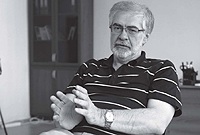
 Beka Mindiachvili: In your view, hybrid regimes cannot survive for long: they either develop into democracies or move towards authoritarianism. How would you describe our current political situation?
Ghia Nodia: It is still too early to say, because our regime remains a hybrid one. The progress made in recent years makes it possible to describe Georgia as a democracy. We now have a state that is reasonably viable, an essential foundation for any democracy, as well as freedoms, albeit fragile ones.
Some say that the Rose Revolution failed to deliver on its promise to establish democracy. That is not true. We should remember that its main slogan at the time was “A Georgia without corruption”. This meant that the state, as an institution, was no longer performing its functions. The revolution was, in fact, a struggle against corruption rather than against Georgia’s lack of democracy. […]
Now that the fundamental issue of corruption has been resolved, if not completely then at least to a large extent, democracy has returned to the forefront. Moreover, and here I am putting forward an unorthodox idea, the consequences of the August 2008 war can be seen as an indirect factor in democratic development. According to some researchers, one of the conditions for democratisation is the definition of borders. A state, a nation, must have clearly defined boundaries in order to know how far its jurisdiction extends, where its borders with other territories lie, and who is or is not a Georgian citizen.
The questions of Abkhazia and South Ossetia must therefore be settled once and for all. Admittedly, the war did not resolve these problems, but it did clarify the situation. We no longer control these territories, and we will not be able to control them for a long time. These issues now belong to the realm of diplomacy and are being discussed in Geneva. […]
Mr Saakashvili promised us that these issues would be resolved during his presidency. In my view, this was an inevitable mistake, because any politician hoping to win an election in Georgia had to make that promise. Today, no sensible politician dares to claim that they will resolve these problems; no one believes it any more. Unfortunately, the issue has been set aside. Nevertheless, the shift in attention back to domestic politics is a positive development for building democracy and democratic institutions.
Today, our nation, the various groups within Georgian society and the government can finally concentrate on developing democratic institutions. This is certainly progress, but it is not enough, because the central issue in democracy is the division of power. This is not simply a matter of the constitutional separation of state powers, but also of pluralism among political elites and within society. From a constitutional point of view, we have gone backwards over the past eight years. The executive is far more powerful than the other branches of government, and the imbalances are clear at both national and regional levels: interest groups and civil-society actors capable of counterbalancing the government are much less visible.
Some scholars of democratic transitions argue that liberal reforms pave the way for democracy. […] Yet democratic regimes are fragile: extremist forces can come to power, as in Ukraine, for example, which, under Russian influence, is moving away from its original course. What can be said about Georgia’s liberal reforms?
[…] We can see that the government and the opposition have different understandings of democracy. Some fear that, in a “truly” democratic Georgia, opposition figures such as Levan Gachechiladze or Sanikidze might come to power. Indeed, the Georgian opposition’s relationship with democracy is rather ambiguous. When it denounces elections, claiming that the government in office was elected by [the provincial towns of] Marneuli and Akhalkalaki [1], it is suggesting that only Tbilisi can legitimately vote, on the grounds that it represents the real Georgia, the true elite. This implies that Azerbaijanis, Armenians and even Mingrelians cannot be trusted. Yet democracy rests on universal suffrage: every citizen is entitled to one vote, regardless of their origin, wealth or opinions.
The government’s actions can also be inconsistent. In a sense, it wears two hats. It holds power while at the same time playing the role of an opposition force, insofar as it sometimes challenges certain tendencies within society in order to change it. From this perspective, the fight against corruption is a form of cultural revolution.
I recently read that liberalism differs from conservatism in that liberals use politics, reforms or economic liberalisation to modernise a country such as ours, whereas conservative forces rely on culture, appropriate it, freeze it in place and confine the population within it. What is the situation in Georgia? It is said that after 2007 reforms were reduced to a slogan and the emphasis shifted mainly towards culture.
One can say that, since 2007, under pressure from the population, the government has become more democratic and less liberal. Hybrid regimes have no choice but to be democratic and therefore, in a sense, populist. Some even argue that democracy is a form of populism. In any case, the government is paying greater attention to society’s demands. It is conducting more and more opinion surveys, as developed democracies do; it identifies target groups, reaches out to people and tries to understand their problems. It is becoming more democratic, but in doing so it must abandon some of the decisions it took when it was more uncompromising and believed that it represented the population and had a popular mandate to do whatever it considered necessary. Before 2007, the country’s modernisation was authoritarian in character. The president’s political role model was Atatürk, who imposed reforms to modernise Turkish society. But Atatürk was not a democrat and did not claim to be one. […]
Today, the Church is the most popular institution in Georgia, so the government has to come to an understanding with it. Moreover, since its liberal reforms are never popular, the government is trying to regain public sympathy. To do so, it instrumentalises nationalism, around which society can easily be mobilised. This does not mean that members of the government are not genuine patriots or believers, but rather that they are pursuing a political strategy to secure acceptance of their reforms. They seek to avoid going against society’s deeply held sentiments.
It is said that religion is an important source of support for liberalism and democracy. In your opinion, is religion more of an obstacle?
If we look at the history of Western democracies, religion has been an important issue everywhere. […] In the 1970s, it was said that democracy could not take root in Eastern Christianity, among Orthodox Christians. I reject this fatalism. Look at Greece, Bulgaria and Romania. They may not be model democracies, but they have made considerable progress. Our Church resembles the Greek Church: traditionally, neither has been an active political player. Unlike Protestant and Catholic churches, they tend instead to maintain a partnership with those in power. In my view, the fact that the Church has become a political force is attributable to politicians on both sides, who are pushing it in that direction.
How does that manifest itself?
This is mainly the work of the opposition. The government, for its part, does not try to activate this lever, but it never ignores it. Since the opposition attempts to instrumentalise religion, the government feels obliged to follow suit.
Yet the Church was scarcely involved in the most recent local elections.
That is because those elections were normal. But when a situation becomes revolutionary, moral considerations, such as religion, always come to the fore. This is not systematic, but it is an observable phenomenon. There are also external disruptive factors, principally coming from Russia. Russia has no pro-Russian levers it can activate in Georgia, so it hopes to stir up anti-Western sentiment. To this end, it intends to rely on the Georgian Church. This in no way means that the entire Church supports Russia, unlike certain religious groups that claim to represent Orthodoxy. Take Gulashvili [2], for example. He does not represent the Church, but he presents himself as a fervent defender of Georgian Orthodoxy. Groups of this kind are Russia’s allies. This is what pushes the Church to become politically active.
So you do not regard the Georgian Church as a cause for concern for democracy.
That is right, because it has become one of the players in the political arena. We have no example of an Orthodox country in which the Church has obstructed democratic development, neither in Russia nor even in Serbia. Some groups within the Church may be culturally close to anti-Western forces, but the tradition of Orthodox churches does not incline them towards political activism aimed at slowing democratisation. The main problem with our democracy is the absence of democratic foundations, not an excess of anti-democratic forces. Without genuine political parties, with civil society still in its infancy and a Constitution that is far from democratic, we cannot raise the standard of democratic life.
According to Charles Fairbanks [3], post-Soviet countries face three types of obstacle: the links between power and money, the absence of the rule of law, and citizens’ passivity.
There is indeed a lack of respect for the law and for the state, the two being connected. But in my view, it cannot be said that we are regressing. There is no longer widespread corruption in Georgia, something that would have been unimaginable not long ago. The hardest thing is to make the government accept that the law can constrain it and that it must comply with the law. This requires civic institutions. Above all, it is the opposition’s role to focus on this, rather than seeking to bring down the government at any cost. Its aim should be to improve the way the country is governed. Take the courts, for example: they require particular attention. All the elements needed to ensure judicial independence – the constitutional foundations and the institutions – are either already in place or being planned. […]
Many claim that the constitutional amendments favour the president. Can Georgia be compared with authoritarian regimes?
Indeed, no change appears likely at the next presidential election. Nevertheless, we cannot speak of authoritarianism, and certainly not of dictatorship. But since there are visible signs of authoritarianism, some say that it is impossible for the same government to be returned to power. […]
How do you assess the most recent local elections, whose results were accepted by the opposition?
These were the fairest elections we have had. However, we face two problems. The Rose Revolution inspired such admiration around the world that some public figures envisage coming to power in the same way. […] Georgian politicians must understand that this is no longer possible. The past three years have inoculated us against this pathological admiration for romantic revolutions, but there are still politicians who have not accepted this. Furthermore, people must be convinced that, if a government becomes unpopular, they can replace it through the ballot box. I do not think the current government has ever reached such a level of unpopularity that the entire population rejected it and it had to resort to force to remain in power. In 2007–2008 we came close to that threshold [4], and even then only in Tbilisi. But it was nothing like 2001–2002, when Shevardnadze had lost credibility throughout the country. However, we do not know what this government might be capable of doing if it were one day to lose public support. […]
Notes
[1] Marneuli and Akhalkalaki are the administrative centres of southern regions whose populations are predominantly ethnic Azerbaijani and Armenian, respectively.
[2] Malkhaz Gulashvili, owner of the Georgian Times, heads an ultra-Orthodox Georgian association and maintains close ties with senior Russian officials.
[3] Charles Fairbanks is director of the Central Asia-Caucasus Institute and professor of international relations at John Hopkins University.
[4] Public discontent and mass demonstrations, harshly suppressed in November 2007, destabilised the president, who brought the presidential election forward to January 2008. Mr Saakashvili then resigned in order to stand as a candidate. He was re-elected with almost 53% of the vote.
* By Beka MINDIACHVILI
Translated from Georgian into French by Sophie Tournon
Translated from French into English by Assen Slim
Link to the French version of the article
Photograph: © Levan Kherkheulidze
Suggested citation: Beka Mindiachvili (2010), “Georgia is not yet a democracy, but a hybrid regime”, Regard sur l’Est, 1 October.