 The Baltic states, Poland and Romania within the EU, but also Ukraine and Moldova—with fairly strong Western backing—and, in a more precarious position, Georgia and Armenia, now remind us that European security can no longer be conceived solely from the traditional centres of power in Paris, Berlin or Brussels. In this anxious Europe, ‘the East’ is no longer a periphery. For all its extraordinary diversity, this part of Europe is becoming one of the places where the continent’s strategic future is being redefined.
The End of the Post-Cold War Illusion
After 1945, Western Europe lived in a world that could be regarded as durably ‘pacified’: until the collapse of the Soviet Union, this admittedly meant the absence of open war rather than a fully guaranteed peace. In the West, moreover, the nuclear threat remained present. In the East, that threat was compounded by the experience of political oppression and Soviet domination. Yet with the collapse of the USSR, the enlargement of the European Union and the continent’s gradual reunification, many came to believe that Europe had entered a new era—even though the Cold War had left deep scars.
This period fostered a powerful conviction: trade, interdependence and common institutions were supposed to make war impossible. The experience of the European Union appeared to confirm this hypothesis. Among former adversaries, economic integration had produced trust, prosperity and lasting peace. It was tempting to extend this reasoning to relations with Russia. Europe’s growing dependence on Russian hydrocarbons could therefore be interpreted not as a vulnerability, but as a bond of mutual interest.
Russia’s full-scale war against Ukraine abruptly ended this illusion: economic interdependence did not prevent Moscow from resorting to force. On the contrary, it exposed Europe’s vulnerabilities, particularly in the energy and military spheres. This return of war to the continent is not entirely unprecedented. The Balkan wars of the 1990s had already demonstrated Europeans’ inability to prevent violence in their own neighbourhood without outside help. Brendan Simms described this as Europe’s ‘unfinest hour’, when it was forced to confront its powerlessness in the face of the crimes committed in Bosnia(1).
Today, the difference is that the threat directly affects Europe’s security architecture. Russia’s aggression against Ukraine, combined with growing doubts about American reliability, has forced Europeans to confront what they had long preferred to put off. Their security can no longer rest solely on the celebrated ‘peace dividend’ or on an automatic US guarantee.
Central and Eastern Europe Confronts the Russian Threat
For the countries of Central and Eastern Europe, the launch of Russia’s full-scale invasion of Ukraine did not carry the same meaning as it did for parts of Western Europe. It reawakened a still-vivid historical memory of Soviet occupation, domination and terror. In these societies, the Russian threat is not a strategic abstraction: it refers to a lived and inherited experience embedded in national and family histories.
This is why the strongest opposition to today’s Russia often comes from the states most directly exposed to the Soviet Union. The Baltic states are the clearest example. Their forced incorporation into the USSR and subsequent return to independence have shaped an acute awareness of sovereignty and vulnerability. Estonia, Latvia and Lithuania have long warned that post-Soviet Russia has never stopped viewing its neighbourhood as a sphere of influence.
Poland also occupies a central place in this geography of vigilance. It was among the first countries to break politically with Soviet domination, notably through the Solidarność movement. This experience partly explains Warsaw’s firm stance towards Moscow. Since 2022, defending Ukraine has not merely been a matter of European solidarity for Poland; it is also seen as a forward line of defence for Central Europe as a whole.
Romania, for its part, still bears the memory of Ceaușescu’s regime and is now exposed to regional tensions linked to the Black Sea, Moldova and the proximity of the war in Ukraine. Under Viktor Orbán, Hungary has occupied a more ambiguous position within the EU. Yet Hungarian history remains marked by the 1956 uprising and by Soviet tanks in Budapest.
Other cases show that the Russian threat is not confined to military force. Slovakia within the EU, and Georgia outside it, illustrate the power of strategies based on influence, division and subversion. Moscow supports or encourages political forces capable of weakening European cohesion, downplaying the aggression against Ukraine or portraying the West as responsible for today’s tensions. This indirect action accompanies conventional warfare and seeks to undermine societies from within.
Ukraine is, of course, the most extreme case of this confrontation—the place where resurgent Russian imperialism has turned into open warfare. Its military and political resistance is changing perceptions of the countries of Central and Eastern Europe, which are now seen as central actors in continental security. These countries bring historical, political and strategic expertise that the West can no longer ignore; they do not merely endure history, but also offer a compelling interpretation of it. For them, peace rests not only on dialogue, trade or institutions: it also requires the ability to resist coercion, defend borders and understand imperial dynamics when they re-emerge. This lesson, long dismissed by some Western partners as excessive or overly alarmist, now lies at the heart of the European security debate.
Western Europe Faces Reality
Faced with Russian aggression, Western Europe reacted more slowly and with greater difficulty than the countries on its eastern flank. This hesitation can be explained in part by a strategic culture shaped by several decades of relative peace, prosperity and confidence in mechanisms of cooperation. For some Western European leaders and members of the public, the idea that a war of conquest could once again target a European state long remained almost unthinkable.
That confidence long sustained an overly optimistic view of Russia. Energy ties, trade and diplomatic frameworks were expected to contain tensions. Germany was the most visible example, since its eastern policy rested on the idea that economic rapprochement could foster political transformation. Other Western European countries shared this conviction to varying degrees. Russia was seen as a difficult and sometimes brutal partner, but one that could still be integrated into a rules-based European order.
The full-scale invasion of Ukraine shattered this view. It also exposed the military unpreparedness of European states. For three decades, the ‘peace dividend’ had made it possible to cut defence budgets and postpone major investments. This appeared rational in a world where interstate war seemed to belong to Europe’s past. Today, it stands revealed as a major vulnerability.
The European Union has not stood idle in the face of Russian aggression. As early as 2014, it imposed sanctions on Russia, while some member states provided financial support to Ukraine and organised arms deliveries and military training. For the EU, this military support marks a significant break with the political habits of the post-1945 era. Yet the response developed in stages, often under pressure from events and from the countries most exposed to the Russian threat, particularly after 2022. It reflects a process of strategic learning rather than an immediate conversion.
This internal difficulty is now compounded by American uncertainty. Since 1945, Western Europe’s security has been built around the guarantees provided by the United States and NATO. That certainty has now begun to fracture. An alliance rests not only on treaties, institutions and military capabilities, but also on confidence in the constancy of its members’ commitments. In a different context, Gregory Miller emphasises the importance of a reputation for reliability in building strategic partnerships(2). Applied to transatlantic relations, this idea illuminates the present fragility. When America’s word becomes uncertain, Europe’s entire security architecture begins to waver.
For the countries of Central and Eastern Europe, this uncertainty is particularly troubling. Their security depends heavily on NATO, but their historical experience makes them wary of guarantees that are too abstract. They know that deterrence works only when it is credible, visible and backed by political resolve. This is why they often call for a stronger military presence on the eastern flank, higher defence investment and a Europe capable of acting even if the United States hesitates.
Western Europe therefore faces a dual challenge. It must rearm not only materially, but intellectually as well. In this new context, Paris, Berlin, Rome and Madrid can no longer ignore what Warsaw, Tallinn, Riga, Vilnius and Kyiv have long been saying.
What the East Can Teach the West
Central and Eastern Europe is no longer seen merely as a region to be protected, but as a source of strategic expertise. Its familiarity with the mechanisms of Russian domination gives its states new legitimacy in the European defence debate.
For the EU, the challenge is not simply to increase military budgets or produce more weapons. It must also accept a shift in perspective. The continent’s security must be built with those who live closest to the threat. It must take on board what Kyiv, Warsaw, Tallinn, Riga, Vilnius, Bucharest and Chișinău have long understood: European peace remains fragile unless it is underpinned by a credible capacity for resistance.
Notes:
(1) Brendan Simms, Unfinest Hour: Britain and the Destruction of Bosnia, Penguin, New York, 2003.
(2) Gregory Miller, “Building space partnership through reliable reputation”, in Thomas Hoerber, Mariel Borowitz, Antonella Forganni and Bruno Reynaud de Sousa (eds.), Routledge Handbook of Space Policy, Routledge, London, 2025, pp. 22–39.
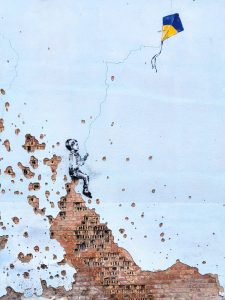
Featured image: On a wall of the destroyed House of Culture in Irpin, Ukraine (photo: Céline Bayou).
* Thomas Hoerber holds the Jean Monnet Chair in European Studies, directs the Jean Monnet Centre of Excellence for European Space Policy and is Director of the EU-Asia Institute at ESSCA School of Management in Angers, France.
** Jakob Dehner is a bachelor’s student in Governance and Public Policy at the University of Passau, an independent liaison officer working with German ministries, and the author of numerous research papers.
To cite this article: Thomas Hoerber and Jakob Dehner (2026), “When Central and Eastern Europe Reawakens the Debate on the Continent’s Security”, Regard sur l’Est, 31 August.

Link to the French version of this article