 Russia’s pronatalist policy faces considerable regional and generational disparities. Decisions about having children depend on economic, social, and political factors, whose significance has been heightened by the full-scale war in Ukraine since 2022. Pronatalist measures must therefore contend with the diversity of regions and individual behaviour.
From Pronatalist Policy to the Management of Demographic Targets
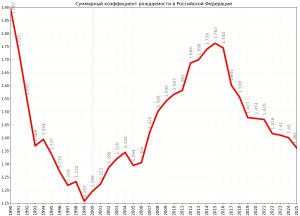
In Russia, policies to encourage births are part of a long-established approach to family support, but the beginning of Vladimir Putin’s fifth presidential term in 2024 marked a new stage in their formalisation. On 7 May 2024, the President signed a decree(1) setting out the Russian Federation's national development goals. The first goal includes “support for the family”. The document sets precise demographic targets: the total fertility rate must reach 1.6 children per woman by 2030 and 1.8 by 2036. These goals are ambitious given the country’s situation: according to Rosstat, the total fertility rate (2) was 1.41 children per woman in 2023, down from 1.78 in 2015. The decree envisages an annual rise in fertility, increasing the number of families with three or more children. Finally, it requires regions whose fertility rates were below the national average in 2023 to catch up with, or even exceed, that average.
The significance of the 2024 decree therefore lies less in its general statement of support for families than in its use as a demographic management instrument: the state now sets a specific outcome to be achieved and requires progress to be monitored at both national and regional levels.
These goals are reflected in the national “Family” project, launched on 1 January 2025 and covering the period 2025–2030. Its scope is broader than a policy simply aimed at increasing births. The program brings together measures relating to financial support, housing, health, large families and infrastructure for children.
The “maternity capital” scheme illustrates the scale of financial intervention. Introduced in 2007, it initially provided 250,000 roubles for the birth of a second child (about €2,700 in 2026). In 2020, the scheme was extended to first children: the amounts were 466,617 roubles (€5,039) for a first child and 616,617 roubles (€6,660) for a second. In 2026, these sums had risen to 728,921.90 roubles (€7,873) and 963,243.17 roubles (€10,403), respectively. The increase is substantial: the amounts provided under the scheme rose by around 56% between 2020 and 2026.
There Is No Single Russian Fertility Pattern: The Role of Regions
Researchers A. Avdeev and I. Troitskaya show(3) that Russia’s demographic trends vary considerably from one region to another.
This territorial dimension is essential to understanding fertility in Russia. In sparsely populated regions, differences between urban and rural areas can be particularly marked. Internal migration also contributes to the concentration of young adults in major urban centers, altering the age structure of both the areas people leave and the ones they move to.
The national average is therefore a necessary but insufficient indicator: the same federal policy is applied to populations with very different demographic structures and patterns of behaviour.
Today, only a small number of regions still record more births than deaths. These are concentrated mainly in the North Caucasus and several Siberian and Russian Far East republics. Between 1995 and 2022, Ingushetia stood out for its substantial natural increase: the excess of births over deaths is estimated to have accounted for around three-quarters of its population growth, amounting to a natural increase of 187,000 people. In Dagestan, natural increase is estimated to have contributed 64% of population growth, equivalent to approximately 880,000 people. These positive trends are mainly observed in republics whose populations have historically consisted predominantly of non-Russian ethnic groups.
However, the geographical concentration of higher fertility is diminishing. Available figures for 2025 show that only two regions, the republics of Chechnya and Tuva, still exceed the replacement-level fertility threshold. Likewise, only three regions—Chechnya, Tuva and Altai—have fertility rates of at least 1.8 children per woman, compared with ten in 2020. These figures therefore show that fertility is declining even in areas previously notable for their demographic vitality.
These uneven conditions matter because the 2024 decree explicitly aims to raise fertility in regions where it falls below the national average. These include the Republic of Mordovia and the Leningrad and Saratov oblasts.
From Intentions to Births: What the Statistics Do Not Tell Us
One limitation of a policy based on birth and fertility indicators is that these figures do not directly reveal individuals’ intentions.
In May 2023, researchers surveyed 7,967 Russians aged 18–44, using a sample representative of the population by sex, age, and place of residence (4). Their aim was to understand how intentions regarding childbearing had changed amid the socio-economic shock of the full-scale war.
The findings particularly reveal the limitations of a policy based solely on financial incentives. In the researchers’ model, the factors accounting for the largest share of explained variance were linked to respondents’ subjective perceptions of the situation and their emotional state. The authors also find that political, war-related, and emotional factors may reinforce one another. People who follow developments in the conflict closely, and those for whom the political situation causes fear or anxiety, are more likely to postpone or avoid pregnancy.
These findings must nevertheless be interpreted with caution: the study measures fertility intentions, not actual births. It therefore identifies an association between perceptions and reproductive plans, but does not allow these intentions to be turned into predictions of future birth numbers.
Available data, meanwhile, show that family policies are being strengthened as birth indicators continue to deteriorate. In 2024, 1,222,408 children were born in Russia, 3.4% fewer than in 2023. The crude birth rate stood at 8.4 births per 1,000 inhabitants. In the same year, 1,818,635 deaths were recorded, resulting in a natural population decrease of 596,227 people. This decrease was greater than in 2023 but broadly similar to that recorded in 2022.
Yet the fall in births is not solely due to changing family preferences. The recent decline in births is also linked to smaller cohorts of women reaching childbearing age, particularly those born in the 1990s. This creates a major difficulty when evaluating public policy. Even if a policy succeeded in maintaining or increasing fertility per woman, total births could continue to fall because the number of women of childbearing age is declining.
Therefore, it is important not to interpret a curve showing the number of births as a direct reflection of policy. Policy affects individuals, whereas statistics capture the outcomes of a population whose composition is changing.
A final complication concerns the territorial scope of Russian statistics. Since 2022, the Russian authorities have included in their statistics Ukrainian territories that they claim have been incorporated into the Russian Federation, despite the contested international status of those territories and the fact that their statistical coverage is not directly comparable with that of other regions. Comparisons over time therefore need to specify the territorial boundaries used, particularly when comparing figures from before and after 2022.
Notes
(1) “Ukaz Prezidenta Rossiiskoi Federatsii ot 7 maia 2024 goda No. 309 ‘O natsionalnykh tseliakh razvitiia Rossiiskoi Federatsii na period do 2030 goda i na perspektivu do 2036 goda’” (Decree of the President of the Russian Federation of 7 May 2024, No. 309, “On the National Development Goals of the Russian Federation up to 2030 and for the Period up to 2036”), Kremlin, 7 May 2024. Official text
(2) “Demography – Demographic indicators”, Rosstat (the statistical portal for demographic indicators of the Russian Federation).
(3) Alexandre Avdeev and Irina Troitskaya, “La Russie en Europe : un géant démographique à la dynamique aussi fragile que celle des autres pays européens”, Espace Populations Sociétés, 2022, special issue 2, pp. 144–152.
(4) Elena Vakulenko, Dmitriy Gorskiy, Valeria Kondrateva and Ilya Trofimenko, “Periods of high uncertainty: How fertility intentions in Russia changed during 2022–2023”, Demographic Research, vol. 52, no. 29, 2025, pp. 939–970.
Thumbnail: Crude birth rate in Russia from 1990 to 2025 (source: Rosstat.gov.ru).
* About the author: Agathe Mallégol is a second-year Master’s student in International Relations, specialising in Russian studies, at INALCO.
Link to the French version of the article
To cite this article: Agathe Mallégol (2026), “Russie : une politique nataliste à l’épreuve des territoires et des comportements”, Regard sur l’Est, 26 October. 
Related article: Russia: Putin’s Pronatalist Policy Between Nationalism and Conservatism